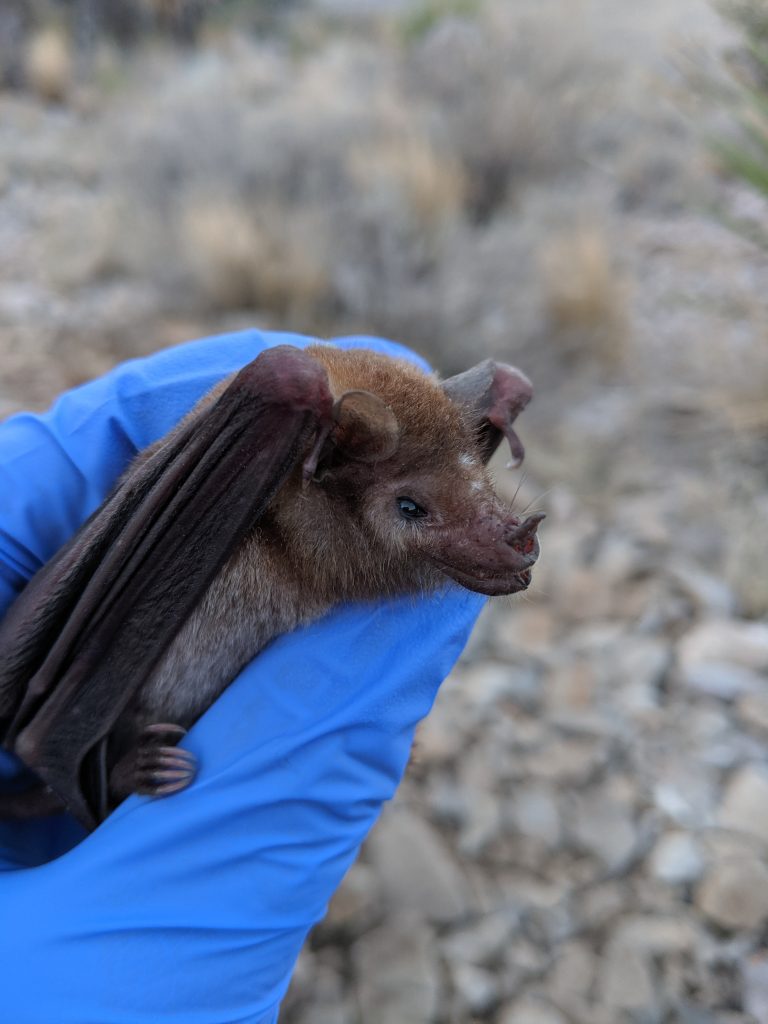
Lesser-long—nosed-bat-(Theresa-Laverty)
The lesser long-nosed bat is one of several bat species that feeds on the flowers of Palmer’s agave as they migrate from south-central Mexico through the southwestern United States.
By Jennifer D’Annibale
The New Mexico Department of Game and Fish (Department) Share with Wildlife program has partnered with Bat Conservation International (BCI) to monitor and improve habitat for nectar-feeding bats on the Double E Wildlife Management Area (WMA).
Double E WMA is on the southwest edge of the Gila National Forest outside of Gila, New Mexico. The Double E WMA consists of large cottonwood and sycamore trees lining Bear Creek, but also has many acres of higher-elevation pinyon juniper hills. In 2020, Department habitat biologist Jennifer D’Annibale officially documented a large, dense patch of Palmer’s agave (Agave palmeri), an important nectar source for nectar-feeding bats, on the Double E WMA. This photo sparked interest from multiple nectar-feeding bat experts as this was one of the most northern locations where this species of agave has been documented.
In New Mexico, the range of Palmer’s agave is primarily in the Bootheel and throughout the Sky islands, and, to a lesser extent, in the Gila region, mostly in the Burro Mountains, so it was exciting to see the presence of agave farther north on the WMA.
A group of nectar-feeding bats forage on the flowers of columnar cacti and agave species, such as the Palmer’s agave. These bats include the Mexican long-tongued bat (Choeronycteris mexicana), Mexican long-nosed bat (Leptonycteris nivalis), and lesser long-nosed bat (Leptonycteris yerbabuenae). These bats migrate from south-central Mexico to the southwestern United States, foraging along the way. The Mexican long-nosed bat is federally listed as Endangered by the United States, and all three of these bats are on the Species of Greatest Conservation Need (SCGN) list that was compiled in the Department’s 2025 State Wildlife Action Plan.
After the patch of Palmer’s agave was confirmed on the Double E WMA, acoustic detectors were deployed in 2021, and the WMA was documented to have high activity of long-nosed bats. However, the two species of long-nosed bats cannot be differentiated using acoustics, so additional survey methods were needed to confirm which species are foraging here. To address this need, the Department partnered with BCI through the Share with Wildlife program in 2024.
BCI is in process of gathering environmental DNA (eDNA) using non-invasive survey method in 2025 and 2026 in order to identify the species foraging on the agave patch. After the eDNA samples are analyzed, BCI will be able to confirm whether the endangered Mexican long-nosed bat and the lesser long-nosed bat species are utilizing the Palmer’s agave on the Double E WMA. Any such detection of the Mexican long-nosed bat will be outside of its known range and thus will be very interesting; the WMA is about 100 miles north of the closest known roost for the endangered Mexican long-nosed bat.If there are high detection rates in any of the collected eDNA samples, that would indicate that this northern patch of Palmer’s agave is an important foraging area for nectar-feeding bats in the late summer before migrating back to Mexico.
Pending determination of nectar bat use, this patch of agaves will only become more important as the state experiences more extreme droughts at lower elevations, where Palmer’s agave is primarily found. This agave patch will provide a food source for these bats as the surrounding area becomes hotter and drier and other food sources potentially die off as a result. However, the Department and BCI recognized that the agave patch on the Double E WMA wasn’t nearly robust enough to support a large population of bats and that it is important to undertake agave habitat enhancement work in the area. To address this issue, BCI collected seeds from the Double E WMA patch and are actively growing out these agave seeds in a nursery to preserve any unique genetic variation exhibited by these agaves. They will also be mapping all the agave on the property and planting Palmer’s agave seedlings, grown out from seeds found in the Peloncillo Mountains, in three separate, ecologically suitable locations on the WMA.
Planting agaves in various locations will allow the Department and BCI to create a more robust population of agaves on the WMA. In addition to improving the agave population and prospective nectar-bat habitat that the agaves provide, the Department also hopes to rehabilitate two or three water sources near the existing agave patch, allowing bats and all wildlife in the area to have access to water year-round. The Department’s Share with Wildlife program was initiated in 1981 to help species that do not receive funding from any other source. The program funds research, education, habitat enhancement, and wildlife rehabilitation projects. It is largely funded through the sale of Share with Wildlife license plates, direct donations, and the state income tax check-off program, along with matching federal funds. More information on the Share with Wildlife program is available on the Department’s website.
Jennifer D’Annibale is the Southwest Habitat Biologist for the New Mexico Department of Game and Fish.